

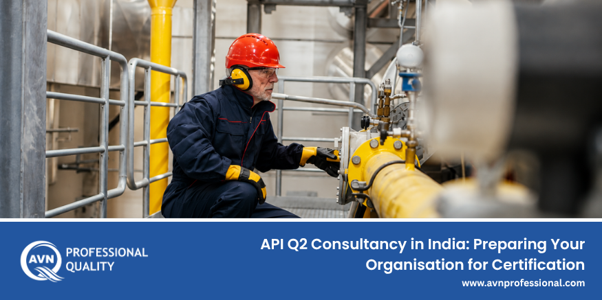
Organisations operating within the oil and gas supply chain are increasingly recognising that quality management is no longer a peripheral function but a core determinant of business survival.
Among the various frameworks governing this sector, API Specification Q2 stands out as a benchmark specifically designed for service supply organisations.
API Specification Q2 is now in its 3rd Edition, published by API on 10 September 2026.
Achieving compliance with this standard, however, is rarely a straightforward exercise, which is why many companies turn to specialised API Q2 consultancy in India to guide them through the intricacies of implementation and certification.
Beyond meeting certification requirements, API Q2 implementation helps organisations strengthen operational consistency, improve risk management, enhance customer confidence, and establish structured processes that support long-term business growth in highly demanding service environments.

Understanding API Specification Q2
Unlike API Q1, which primarily addresses product manufacturers, Specification Q2 was developed for service supply organisations. Its 3rd Edition narrows this further to organisations providing well-site services in the petroleum and natural gas industries, and clarifies how Q2 relates to Q1.
This includes organisations engaged in well construction, drilling, well intervention and servicing, production and abandonment, together with inspection and testing carried out as part of those well-site services.
An important change under the 3rd Edition is that API no longer accepts Q2 certificate scopes that list stand-alone services such as calibration, engineering, design, training or technical consulting, NDE inspection, transportation, project management, software provision, manufacturing, or rental without an accompanying well-site service. These activities can still appear on a certificate when they form part of an eligible service. Organisations whose scope becomes wholly ineligible will have their Q2 registration withdrawn after their transition audit, and API encourages them to consider API Q1 instead.
The standard establishes requirements around risk management, competency of personnel, management of change, and continual improvement, all tailored to the dynamic and often hazardous environments in which these services are rendered.
Given the breadth of this framework, service organisations frequently find themselves grappling with unfamiliar terminology, complex risk-based thinking requirements, and documentation expectations that differ substantially from conventional quality systems such as ISO 9001.
Bridging this gap demands not just awareness but structured, hands-on support.
Why Service Organisations Require Specialised Support
Many companies attempting to pursue Q2 certification independently encounter recurring obstacles. These typically include:
- Difficulty translating risk assessment principles into practical, field-applicable procedures
- Insufficient competency management systems for personnel deployed at remote or offshore locations
- Inadequate mechanisms for managing change across dynamic operational environments
- Poor integration between corporate quality policies and actual field practices
- Limited internal experience in preparing for and undergoing third-party audits
These gaps often lead to prolonged certification timelines, repeated non-conformities, and, in some cases, complete audit failure.
Recognising these patterns, forward-thinking organisations increasingly engage professional API Q2 certification consultant services rather than relying solely on internal resources stretched thin across operational priorities.
Core Elements of Effective Q2 Preparation
Successful certification under this specification rests on several interconnected pillars, each requiring deliberate attention during the preparation phase.
- Risk-Based Thinking Embedded Across Operations
Specification Q2 places considerable emphasis on identifying and mitigating risks associated with service delivery, rather than merely documenting procedures for their own sake. Organisations must demonstrate that risk considerations genuinely influence how work is planned, executed, and reviewed, from the boardroom down to the wellsite.
- Competency and Training Frameworks
Given the safety-critical nature of field services, personnel competency cannot be assumed; it must be systematically evaluated, documented, and periodically reassessed. Building a defensible competency management system often represents one of the more resource-intensive aspects of preparation.
- Robust Management of Change Procedures
Field operations are inherently subject to shifting conditions, whether due to equipment substitutions, personnel changes, or unexpected site circumstances. A compliant system requires formal mechanisms to evaluate and approve such changes before they introduce unacceptable risk.
- Documented Evidence of Continual Improvement
Auditors expect to see tangible proof that lessons learned from incidents, near-misses, and operational reviews genuinely feed back into procedural refinement, rather than existing only on paper.
- Alignment of Corporate Policy with Field Reality
Perhaps the most common shortfall observed during audits is a disconnect between what corporate documentation states and what actually occurs at the point of service delivery. Closing this gap requires deliberate coordination between management and field personnel throughout the preparation process.
The Value of Professional Q2 Implementation Services
Given the technical depth of these requirements, many organisations find that engaging dedicated API Q2 implementation services considerably shortens their journey towards certification.
Rather than attempting to interpret the specification in isolation, companies benefit from structured support that translates abstract clauses into workable, field-ready procedures.
Implementation support typically encompasses:
- Conducting an initial readiness assessment against the current state of the organisation’s quality and safety systems
- Confirming that the organisation’s certificate scope meets the 3rd Edition’s well-site service applicability rules
- Developing or refining the Quality Manual, risk registers, record-retention arrangements (now 10 years) and supporting procedures in alignment with the 3rd Edition of API Q2
- Building competency matrices and training programmes suited to various field roles
- Establishing internal audit protocols to test the system before the formal certification audit
- Facilitating communication between corporate quality teams and field supervisors to ensure consistent understanding
- Providing hands-on coaching during mock audits to build organisational confidence
This structured approach reduces the likelihood of surprises during the actual certification audit while embedding practices that genuinely strengthen operational safety and reliability.
Transitioning from the 2nd to the 3rd Edition
For organisations already registered to API Q2, the key dates are voluntary audits to the 3rd Edition from 1 February 2027; new applicants audited to the 3rd Edition from 5 April 2027; full implementation and audit to the 3rd Edition by 1 October 2027; and withdrawal of any remaining 2nd Edition certificates on 1 October 2029. A focused gap analysis against the new edition, together with a scope review, is the most practical way to plan the transition well before these deadlines.
How AVN Professional Supports Organisations Pursuing Q2 Certification
AVN Professional has established itself as a dependable partner for service organisations navigating the demands of API Q2 compliance. Their offerings extend across the entire certification lifecycle, combining practical consultancy with structured training and ongoing advisory support.
Companies engaging with AVN Professional for their API Q2 compliance consultancy needs typically receive assistance across several dimensions:
Comprehensive Gap Analysis: Before any implementation work begins, the current state of the organisation’s management systems is thoroughly evaluated against Q2 requirements, identifying specific areas requiring attention.
Tailored Documentation Development: Rather than imposing generic templates, documentation is developed to genuinely reflect the organisation’s actual service offerings, operational footprint, and risk profile.
Field-Level Training: Recognising that certification success depends heavily on field personnel understanding and applying the system, training sessions are designed to resonate with on-ground realities rather than remaining confined to conference rooms.
Mock Audits and Readiness Verification: Simulated audits conducted ahead of the formal certification assessment allow organisations to address weaknesses proactively, considerably improving first-attempt success rates.
Post-Certification Support: Maintaining compliance requires sustained effort well beyond the initial audit. Continued guidance helps organisations remain prepared for periodic surveillance assessments and evolving specification requirements.
This includes planning and preparing for the transition audit to the 3rd Edition of API Q2 before the 1 October 2027 deadline.
By weaving these elements together, AVN Professional enables organisations to pursue certification methodically, minimising disruption to ongoing operations while building genuinely resilient management systems.
Benefits of Investing in Structured Q2 Consultancy
Organisations that commit to professional guidance throughout their certification journey typically experience several measurable advantages:
Faster Certification Timelines: Structured preparation considerably reduces the back-and-forth often associated with self-directed attempts, allowing organisations to achieve certification within a predictable timeframe.
Fewer Audit Non-Conformities: Thorough preparation, including mock audits, significantly lowers the number of findings raised during the formal assessment.
Stronger Safety Culture: The risk-based thinking embedded through Q2 implementation often translates into tangible improvements in field safety practices, extending benefits well beyond mere compliance.
Enhanced Client Confidence: Certified organisations gain a distinct advantage when bidding for contracts with operators who mandate Q2 compliance as a prerequisite for engagement.
Sustainable Internal Capability: Properly trained personnel develop lasting competence in maintaining the system, reducing long-term reliance on external support for routine matters.
Selecting the Right Consultancy Partner
Choosing the right provider for API Q2 consultancy in India is essential for achieving certification efficiently and building a robust management system.
An experienced consultancy partner offers practical guidance that goes beyond documentation, helping organisations implement processes that deliver long-term value.
What to Look For
- Proven expertise in API Q2 consultancy in India across relevant service sectors.
- Up-to-date knowledge of the API Q2 3rd Edition (2026) and API’s transition and scope-eligibility rules.
- A strong track record of supporting organisations through successful API Q2 certification projects.
- Practical understanding of field operations, risk management, and compliance requirements.
- Comprehensive support covering gap analysis, implementation, audit preparation, and post-certification guidance.
Selecting a knowledgeable consultancy partner reduces implementation challenges, improves audit readiness, and helps organisations establish sustainable systems that support compliance, operational excellence, and continued business growth.
Strengthen Your Business with AVN Professional Quality
Achieving API Q2 certification becomes far more efficient with expert API Q2 implementation services tailored to your organisation’s operational needs.
AVN Professional Quality provides end-to-end consultancy, helping businesses establish compliant management systems, strengthen risk management practices, and prepare confidently for certification audits.
From gap assessments and documentation to implementation and ongoing support, our experienced team guides you through every stage of the process.
Contact AVN Professional Quality today to learn how our API Q2 implementation services can help your organisation achieve certification, improve operational performance, and build long-term credibility in the global oil and gas industry.
Frequently Asked Questions API Q2 Consultancy
- How is API Q2 different from API Q1, and do organisations need both?
API Q1 applies mainly to manufacturers of products and equipment (and, since its 10th Edition, to some service and product-related activities), while API Q2 is designed for organisations providing well-site services such as well construction, intervention, production and abandonment. Under the Q2 3rd Edition (2026), stand-alone services such as calibration, NDE inspection, design or training can no longer appear as the only scope on a Q2 certificate, and API points such organisations towards Q1. Businesses offering both manufacturing and well-site services may require certification under both standards.
- How long does the API Q2 certification process take?
With professional consultancy, most organisations complete the certification journey within 5–9 months. The duration depends on existing management systems, documentation, and the complexity of operations across different locations.
Note: organisations applying from 5 April 2027 onward will be audited to the 3rd Edition, so new projects starting now should be built on the 3rd Edition requirements.
- Is API Q2 suitable for small service providers?
Yes. Small and medium-sized service providers can successfully achieve API Q2 certification. Expert guidance helps implement compliant systems efficiently without placing unnecessary pressure on daily operations.
- What happens after API Q2 certification?
Organisations must maintain compliance through regular surveillance audits, updated documentation, effective risk management, and continuous process improvement to ensure the certification remains valid and effective over time.
Existing certificate holders must also transition to the API Q2 3rd Edition and be audited to it by 1 October 2027.
- Does the new API Q2 3rd Edition affect my existing certificate?
Yes. API published the 3rd Edition on 10 September 2026. Registered organisations must implement it and be audited to it by 1 October 2027, and API is reviewing certificate scopes, so organisations offering only stand-alone services such as calibration, NDE inspection or technical consulting should review their eligibility now.
